



Calibre 177 vs 22: Air Rifle – Which Calibre Is Right for You?
Calibre choice is one of the first decisions air rifle shooters face - and one of the easiest to get wrong. In calibre 177 vs 22, the main difference is performance: .177 pellets are lighter, faster and flatter-shooting, which suits target work, while .22 pellets are heavier, slower and hit harder, which makes them better suited to pest control and hunting. That choice affects accuracy, trajectory and downrange energy, so matching calibre to your primary use is the clearest path to better results from day one.
For new and experienced shooters alike - whether you shoot club sporter, compete, control pests or hunt - the useful comparison is not pellet size alone, but how each calibre behaves within UK legal power limits and in real field conditions. Air Arms manufactures rifles in both calibres across multiple platforms - from the competition-ready Ultimate Sporter to the versatile TX200 and S510 Tactical - each designed with specific disciplines in mind, reflected in a broad line-up of high-performance air rifle products. With over 40 years of British engineering expertise behind every rifle, the calibre options are not arbitrary, but integrated into carefully developed product families for different shooting disciplines. This guide compares the technical and practical differences between .177 and .22, including accuracy, performance, legal considerations and which Air Arms rifle best fits the way you shoot.
What's the Actual Difference Between .177 and .22?
The numbers refer to pellet diameter. A .177 pellet measures approximately 4.5mm across; a .22 pellet measures approximately 5.5mm. That 1mm difference in diameter produces meaningful differences in how each calibre behaves downrange.
.177 pellets are lighter. Because of that, they leave the muzzle at higher velocity when fired from a rifle of the same power output, often by around 200 feet per second. Higher speed means a flatter trajectory, so there is less drop over a given distance, which makes .177 more suitable at longer range and ideal for precise shots at smaller targets between 10 and 55 metres.
.22 pellets are heavier and wider. They travel at lower velocity from an equivalent power source, which gives them a more loopy trajectory and means the shooter has to judge distance and pellet drop more carefully. What they carry is more energy at the point of impact, with better stopping power at close to medium range - useful when the goal is a clean, humane result on live quarry rather than a precise hole in a paper target.
Pellet size at a glance
.177 (4.5mm) - lighter, faster, flatter trajectory. .22 (5.5mm) - heavier, slower, greater impact energy. Both are legal and widely used in the UK across different disciplines.
Wind drift is also a factor. Lighter .177 pellets are more affected by crosswind than heavier .22 pellets at equivalent distances. In calm, controlled conditions like an indoor range or sheltered field target course, this rarely matters. In open outdoor environments with variable wind, the difference becomes more noticeable.
Both calibres can be highly accurate, but accuracy often depends much more on rifle design and quality than calibre alone.
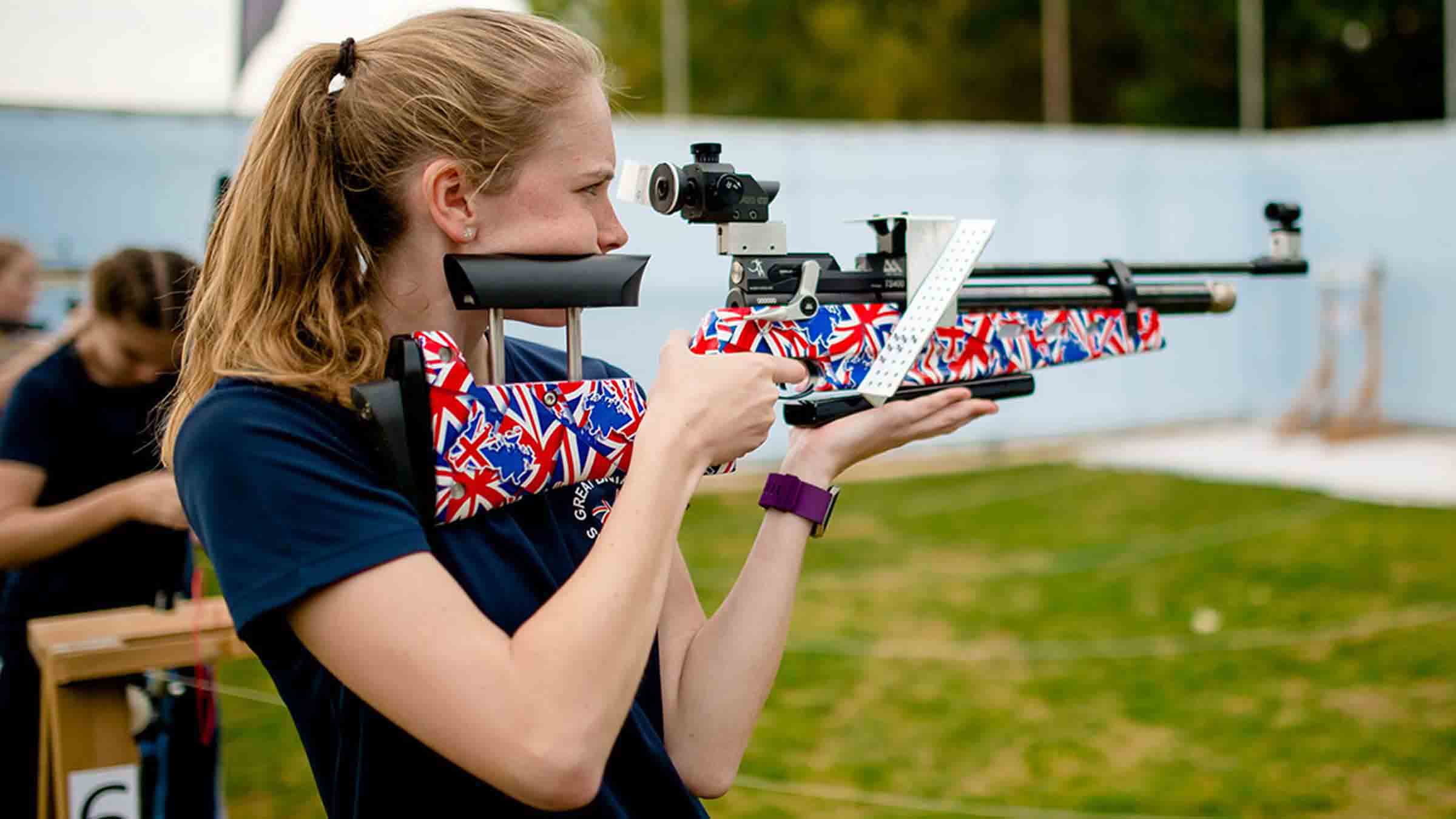
Why .177 Dominates Target and Sporter Shooting
Most competitive air rifle disciplines in the UK - including 10 metre Olympic-style target shooting, Field Target, and club sporter competitions - are shot in .177, which is the standard for 10-metre target shooting competitions and the preferred choice for formal target practice. That's not a coincidence.
At 10 metres, the difference in trajectory between .177 and .22 is minimal, though .177 is designed for speed and precision. But as distances extend to 25, 35, and 55 metres - as they do in sporter and field target disciplines - the flatter trajectory of .177 becomes a genuine competitive advantage, especially when compensating for pellet drop at longer ranges. Less holdover means fewer variables to manage and a higher margin for precision.
- Flatter trajectory at extended sporter distances (25 - 55m)
- Less holdover adjustment required between targets at different ranges
- Better suited to precision scoring on small target faces
- Standard calibre across most UK club competitions and field target courses
- Wider pellet availability at club and competition level
The Air Arms Ultimate Sporter reflects this directly. Available in .177 and a multiple Airgun of the Year award winner, it is a purpose-built platform designed for sporter and precision shooting disciplines. The calibre choice is not incidental — it is central to the design intent. The Ultimate Sporter is championship-proven across sporter disciplines, and choosing .177 aligns the shooter with how that rifle was engineered to perform.
Why competition shooters standardise on .177
Most UK sporter and field target competitions are structured around .177 as the standard calibre. Shooters who enter these disciplines with a .22 may find themselves at a practical disadvantage - not because the rifle is inferior, but because the calibre was not designed for that application. Its flatter trajectory also makes it easier to aim for more consistent shot placement in competition settings.
For a shooter whose primary goal is to develop accuracy at a club, enjoy some backyard plinking, improve their score in sporter competitions, or move into precision target shooting, .177 is the natural starting point. It is not about preference - it is about matching the tool to the discipline.
Where .22 Has the Edge: Pest Control and Hunting
The case for .22 becomes clear when the target is live quarry rather than paper or steel, and many hunters look beyond .177 and .22 when deciding which air rifle calibre is best for hunting larger quarry or shooting at extended ranges. Humane pest control depends on matching calibre to the target species, and within the 12 ft/lb legal limit .22 pellets deliver more energy upon impact than .177 pellets to dispatch quarry quickly and cleanly. Within that same limit, .22 is generally favoured in the UK for air rifle hunting at close ranges of around 30 yards, where its heavier weight gives more stopping power at typical field distances. Its larger diameter also creates a wider wound channel and offers a slightly larger margin for error on vital shots.
The heavier .22 pellet also resists deflection better when passing through light foliage or disturbed air - a real consideration in outdoor hunting environments where .22 typically performs better in windy conditions. It carries its energy further into the target, which matters when quarry size and shot placement cannot always be controlled as precisely as they are on a range.
- Greater energy at impact within the 12 ft/lb legal limit
- Better suited to clean, humane dispatch of pests and small game
- A heavier pellet more resistant to deflection in variable outdoor conditions
- Preferred calibre for most UK pest controllers and hunters working at short field distances
The Air Arms TX200 and S510 Tactical are both available in .22, giving hunters and pest controllers access to proven, high-quality platforms in the calibre that suits their application, and they rank among the best .22 air rifles for hunting in typical UK field conditions. The TX200 - a spring-powered underlever with a reputation for consistency and reliability - and the S510 Tactical - a regulated PCP with modular ergonomics - both perform strongly in .22 for field use. For smaller pests such as rats and squirrels, shooters dealing with them may still favor .177 because its lighter pellet weight and higher velocity give a flatter trajectory at short ranges, while many .22 users choose a heavier pellet such as the Bisley Magnum for humane kills that depend on both calibre and shot placement, and focus on choosing the best .22 pellets for air rifle hunting to maximise performance on similar quarry.
Shot placement matters more than calibre
Even with the energy advantage of .22, accurate shot placement is the most important factor in humane pest control, though it is often the preferred choice for hunting small game at short field distances. A well-placed .177 pellet from a skilled shooter will outperform a poorly placed .22. Calibre gives you the right tool - the shooter still has to use it correctly.
Can You Use One Calibre for Everything?
This is the question many new shooters ask - and the honest answer is: to a degree, yes, but one-calibre-for-everything decisions depend on intended use, what you want the rifle to do best, and how much versatility you need. There are meaningful trade-offs depending on which direction you go.
A .177 rifle can be used for pest control. At typical airgun hunting ranges, it is capable of dispatching small quarry with accurate shot placement. However, the energy advantage of .22 at impact is real, and a pest controller relying on .177 must be confident in their accuracy and range discipline to compensate. Both calibres can be accurate, but they tend to excel in different conditions. For occasional opportunistic pest control by someone who primarily shoots targets, .177 is workable.
A .22 rifle can be used for target and sporter shooting. Plenty of shooters enjoy informal club practice with a .22. The limitation comes when competing or shooting at longer sporter distances, where the extra holdover and wind drift correction required in varying shooting conditions puts the .22 shooter at a consistent disadvantage versus .177 competitors shooting the same course, due to its slower speed and extra drop at distance.
A practical scenario
A club shooter who also manages rabbits on a family farm faces a genuine calibre dilemma. Shooting predominantly at the club — 25 to 55 metre sporter targets — their performance will be stronger in .177. For the occasional pest control session, a .22 would be more effective. In practice, many shooters in this position end up owning one rifle in each calibre over time, as different calibres suit mixed roles more effectively. Starting with .177 makes sense if the club is the primary focus and that remains the intended use.
The core advice is to let your primary discipline lead the decision. A rifle optimised for what you do most often will serve you better than one chosen as a compromise across multiple uses.
Choosing the Right Calibre: Which Air Arms Rifle Fits Your Discipline?
The right calibre decision starts with one straightforward question: what do you really need the rifle to do most of the time? Everything else follows from there.
Matching Calibre to Discipline
Club Target and Sporter Shooting
Choose .177. The flatter trajectory, lower holdover requirement, and alignment with standard competition formats make .177 the clear choice for any shooter whose primary goal is improving accuracy at a club, competing in sporter events, or progressing toward field target, and it is often the preferred choice for shooters focused on formal competition or regular practice. The Air Arms Ultimate Sporter is available in .177 and is built specifically for this application - a championship-proven platform that reflects exactly this discipline-led thinking.
Pest Control and Hunting
Choose .22. The greater impact energy and resistance to deflection in variable outdoor conditions make .22 the practical choice for anyone primarily focused on pest management or hunting small quarry. The Air Arms TX200 and S510 Tactical are both available in .22 and deliver the consistency and reliability that field shooting demands.
General Use and Getting Started
Start with .177. For shooters who are new to air guns and not yet committed to a single discipline, .177 gives you access to the widest range of club activities, competitions, and training formats. It is often the ideal all-round starting point for club use, informal practice, and skill building. It is also widely available in terms of pellet supply, and .177 pellets are usually a couple of quid cheaper than .22, so cost and price can be practical factors for beginners. You can always add a second rifle later as your discipline focus becomes clear.
Mixed Use
Consider which use comes first. If you shoot at a club three times a month and manage pests occasionally, lead with .177. If you spend most weekends in the field and visit the club occasionally, lead with .22. If you want one platform in two roles, Air Arms offers the same gun in different calibres, which adds useful versatility, though the advantages of each calibre only matter when matched to the shooter's real intended role. The TX200 and S510 Tactical, available in both calibres, give you the option to own the same platform in the calibre that suits each application.
Air Arms rifles are manufactured in the UK with over 40 years of engineering expertise behind every platform, underpinned by a clear promise of quality and performance across the entire range. In many cases, build quality matters more than calibre alone. Whether you choose .177 or .22, the quality of the rifle - the barrel, the action, the trigger, the regulation - remains the same. Calibre shapes what the rifle is optimised for. The engineering ensures it performs.
Built for the discipline, not just the calibre
Air Arms rifles come with a 3-year warranty and are supported by a dedicated aftersales and repair network through authorised dealers across the UK. Whichever calibre you choose, you're backed by a manufacturer that stands behind its products for the long term.
The .177 vs .22 air rifle question does not have a single right answer — but it does have a right answer for your situation. Define your primary discipline, and the calibre decision becomes straightforward. You and Air Arms: a winning combination.
Find the Right Rifle for Your Shooting
Find the Right Rifle for Your Shooting
Explore the full Air Arms rifle range - available in .177 and .22 across multiple disciplines. Whether you're stepping into club shooting for the first time or looking for a dedicated field rifle, our authorised retailer network is on hand to help you see which calibre and platform fit how you shoot, and take the next step with confidence. Also consider the environmental impact of pellet choice, as lead pellets pose environmental hazards because lead exposure can harm wildlife and ecosystems, while non-lead alternatives are increasingly available; happy shooting.